
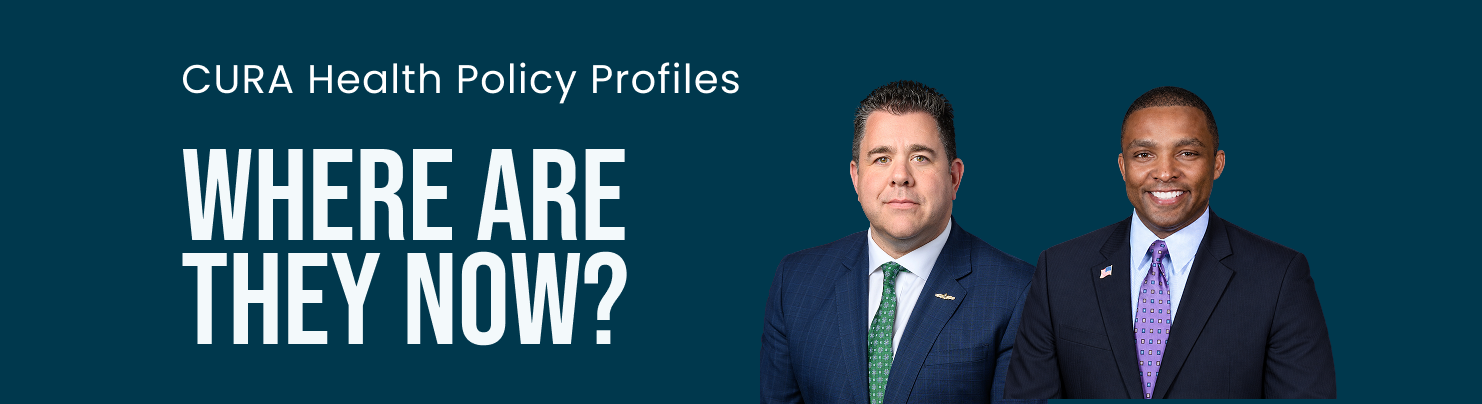

Four years since naming our 2022 “Top 12 Freshman Members to Watch in the 118th Congress,” CURA is continuing to track how those once-freshman lawmakers are translating their backgrounds and priorities into health policy action. After revisiting Reps. Brittany Pettersen (D-CO) and Jen Kiggans (R-VA) earlier this year, we’re now spotlighting Reps. Don Davis (D-NC) and Nick LaLota (R-NY).
Both came to Congress with military and public-service experience, but their records reflect the distinct needs of the communities they represent. Davis has focused heavily on strengthening rural health care and veterans’ services in eastern North Carolina, including his push to shore up funding for rural hospitals after a local emergency room closure left thousands without nearby care. LaLota has prioritized affordability, safety-net hospitals and access to care for veterans and other patients — work that’s already translated into signed law protecting Medicaid funding for the hospitals serving Long Island’s most vulnerable residents.
Read on for a closer look at their career journeys, legislative records and perspectives on the healthcare challenges facing their constituents.
Representative Don Davis (D-NC):
Representative Don Davis’s background in public service, education and the military has shaped his approach to health policy. He was first elected mayor of Snow Hill, North Carolina in 2002 and later served in the North Carolina State Senate beginning in 2008, where he was a member of the Health Care Committee. Alongside his legislative career, Davis served eight years in the U.S. Air Force, taught at East Carolina University for more than two decades, and still serves as a minister in the same church he grew up in.
Since coming to Congress, Davis has prioritized improving healthcare access and affordability for rural communities and veterans, responding to long-standing care gaps across eastern North Carolina and other underserved areas.
He has advanced these goals through bipartisan legislation, including co-leading the Bipartisan Health Insurance Affordability Act to extend enhanced ACA tax credits, strengthen consumer protections, curb spread pricing and expand access to Health Savings Accounts (HSAs). Rep. Davis has also prioritized veterans’ health and access to services, sponsoring legislation such as the Rural Veterans Transportation to Care Act and the DOULA for VA Act of 2023. As vice ranking member of the House Armed Services Committee, he also shapes policies affecting active duty servicemembers and military families. His military health work includes efforts to expand TRICARE coverage, including serving as an original co-sponsor of the Health Care Fairness for Military Families Act, which would extend dependent coverage under the TRICARE Young Adult Program through age 26. His Rural Veterans Transportation to Care Act would also expand transportation assistance for veterans traveling to VA or VA-authorized healthcare facilities.
“We must be laser-focused on confronting the rural health crisis and closing care gaps that have left communities without reliable access to treatment. North Carolina’s First Congressional District has been on the frontlines of this challenge since the 2023 closure of Martin General Hospital, which left nearly 22,000 residents without local emergency care and highlighted the fragility of rural health systems. In response, I introduced H.R. 4277, the Rural Emergency Hospital Financial Stability Act, to increase Medicaid reimbursement rates for these facilities and to provide a lifeline for struggling rural hospitals.
In addition, we have prioritized care for those who served our nation by passing legislation that I sponsored in the 118th Congress to cut red tape for veterans applying for the VA Caregivers program, as part of the landmark Senator Elizabeth Dole 21st Century Veterans Healthcare and Benefits Improvement Act.”
In the 119th Congress, Davis has sponsored or co-sponsored numerous health-related bills, including the Maintaining Investments in New Innovation Act and the Rural Emergency Hospital Financial Stability Act.
Davis’s caucus memberships reinforce his array of health policy interests: He is a member of the Bipartisan Rural Health Caucus, the State Medicaid Expansion Caucus, the Tobacco Harm Reduction Caucus, the For Country Caucus, the Democratic Veterans Caucus and the Veterinary Medicine Caucus.
Representative Davis has supported legislation that would:
- Strengthen rural hospitals and stabilize emergency care in underserved communities
- Expand and modernize Medicare coverage, including for emergency medical services and multi-cancer early detection screening
- Reform pharmacy benefit managers (PBMs) by increasing transparency and improving pharmacy reimbursement and patient access
- Extend funding for Type 1 diabetes programs and protect access to clinical diagnostic laboratory testing
- Improve healthcare workforce recruitment, training and retention
- Expand access to telehealth services
- Support research and funding for Alzheimer’s disease, uterine cancer, autism, stillbirth and environmental risk factors for neurodegenerative diseases
- Protect access to in vitro fertilization (IVF) and other reproductive health services
- Improve senior care by strengthening prior authorization standards under Medicare Advantage
- Award priority review vouchers for treatments targeting rare pediatric diseases
- Expand mental health services and suicide prevention resources
- Promote affordable insurance coverage and stabilize health insurance markets
- Broaden TRICARE coverage, including by extending dependent coverage through age 26
- Improve veterans’ access to VA healthcare and caregiver support by offering transportation assistance for rural veterans and expanding the availability of doula services
Bottom line: Representative Davis’s record reflects a consistent emphasis on improving healthcare access, affordability and system stability, with particular attention to rural communities and veterans. Drawing on decades of service at both the local and state levels, as well as his military and faith-based leadership, his approach centers on practical, bipartisan solutions aimed at ensuring that geography, income or service history do not stand in the way of quality healthcare.
Representative Nick LaLota (R-NY):
Representative Nick LaLota brings a background in military service and local government to his health policy platform. A U.S. Navy veteran, LaLota was a surface warfare officer before entering public service at the local level on Long Island. From the start of his congressional tenure, he has emphasized bipartisan problem-solving, particularly on issues related to healthcare access and affordability.
Since coming to Congress, LaLota has focused on improving healthcare affordability, strengthening veterans’ health services and expanding access to innovative care delivery models. His bipartisan approach has been most visible in his work on insurance affordability. He was one of only 17 Republicans to vote to extend the Affordable Care Act’s enhanced Premium Tax Credits for three years while reforms are underway, positioning him as a pivotal bipartisan partner in efforts to stabilize insurance markets and reduce costs for working families.
LaLota has sponsored legislation aimed at protecting hospitals that serve high-need populations. His Save Our Safety-Net Hospitals Act focuses on strengthening the financial stability of hospitals that care for large numbers of low-income and vulnerable patients. The bill’s Medicaid Disproportionate Share Hospital payment protections were incorporated into the Consolidated Appropriations Act, 2026, and signed into law.
He also sponsored the bipartisan Vietnam Veterans Liver Fluke Cancer Study Act, which passed the House in both the 118th and 119th Congresses and would require the Department of Veterans Affairs, in consultation with the Centers for Disease Control and Prevention, to study the prevalence of bile duct cancer among Vietnam veterans.
“Long Island has some of the highest cancer rates in the country, one of the largest veteran communities in New York, and families who depend on safety net hospitals to be there when they need them most. I was proud to secure Medicaid Disproportionate Share Hospital funding protections that keep those doors open for our most vulnerable neighbors. Since then, I’ve been fighting for patients with breast cancer, ALS, kidney disease and diabetes who are waiting on treatments their doctors prescribed, and for seniors in Medicare Advantage whose care is being by insurers making billions while rejecting legitimate claims. My approach is straightforward: Direct federal support to patients and the providers who serve them, remove the regulatory and administrative barriers that delay access to care, and make sure Long Island families can count on a healthcare system that actually works for them.”
Rep. LaLota’s caucus memberships underscore his devotion to a series of health priorities, spanning chronic disease, neurological and rare conditions, and veterans’ health. He is a member of the ALS Caucus, Colorectal Cancer Caucus, Diabetes Caucus, Down Syndrome Caucus, Epilepsy Caucus, Rare Disease Caucus, Tourette’s Syndrome Caucus, Lyme and Tick-Borne Disease Caucus and the Military Veterans Caucus.
In the 118th and 119th Congresses, Representative LaLota has co-sponsored health policy legislation that:
- Strengthen Medicare Advantage oversight by establishing prior authorization standards
- Allow essential caregivers access to skilled nursing facilities during periods of restriction
- Protect seniors’ access to critical medications
- Support access to in vitro fertilization (IVF) and other reproductive health services
- Prohibit animal testing in cosmetic product evaluation
- Improve protections for dialysis patients
- Simplify Medicare and Medicaid enrollment processes
- Safeguard patient privacy in telehealth services
- Expand behavioral health services for law enforcement officers
- Increase the number of residency positions eligible for graduate medical education
- Require health plans to apply certain payments toward beneficiary cost-sharing requirements
- Improve accountability and investment in Alzheimer’s disease research
- Preserve patient access to long-term care pharmacies
- Expand access to telehealth services
- Allow Medicaid payment for health services provided to incarcerated individuals
- Advance research on the health effects of microplastics
- Strengthen pediatric access to care through the Give Kids a Chance Act
- Expand Medicare coverage for multi-cancer early detection screening
Bottom Line: Representative LaLota’s health policy record leads with affordability, access and system stability, paired with a willingness to work across party lines on insurance coverage and patient protections. Inspired by his service in the military and local government, his approach centers practical solutions that improve care delivery while prioritizing patients, families and veterans.
Together, Davis and LaLota illustrate how backgrounds forged in military and public service can translate into distinct, but complementary, solutions to America’s biggest healthcare challenges. CURA will continue tracking the original “Top 12” as their records take shape — and this November, we’ll release our full 2026 edition of Health Policy Profiles. Stay tuned for more details!

Maddie Helmus
Assistant Account Executive
Government Relations